Choosing a skin-tightening treatment is about more than how deeply a device can reach. A balanced facial result depends on matching the treatment to the skin, supporting tissues and contours that need attention.
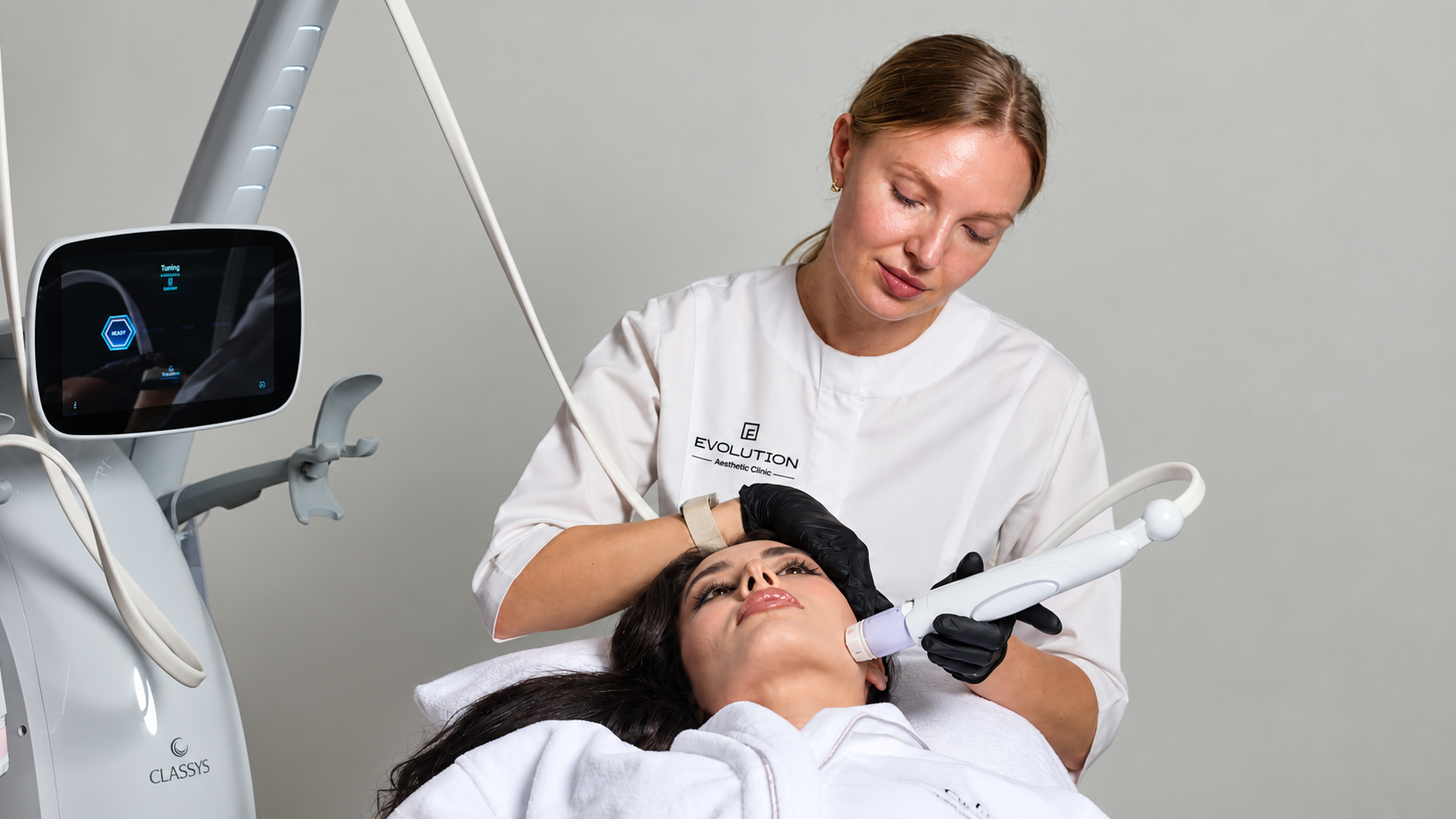
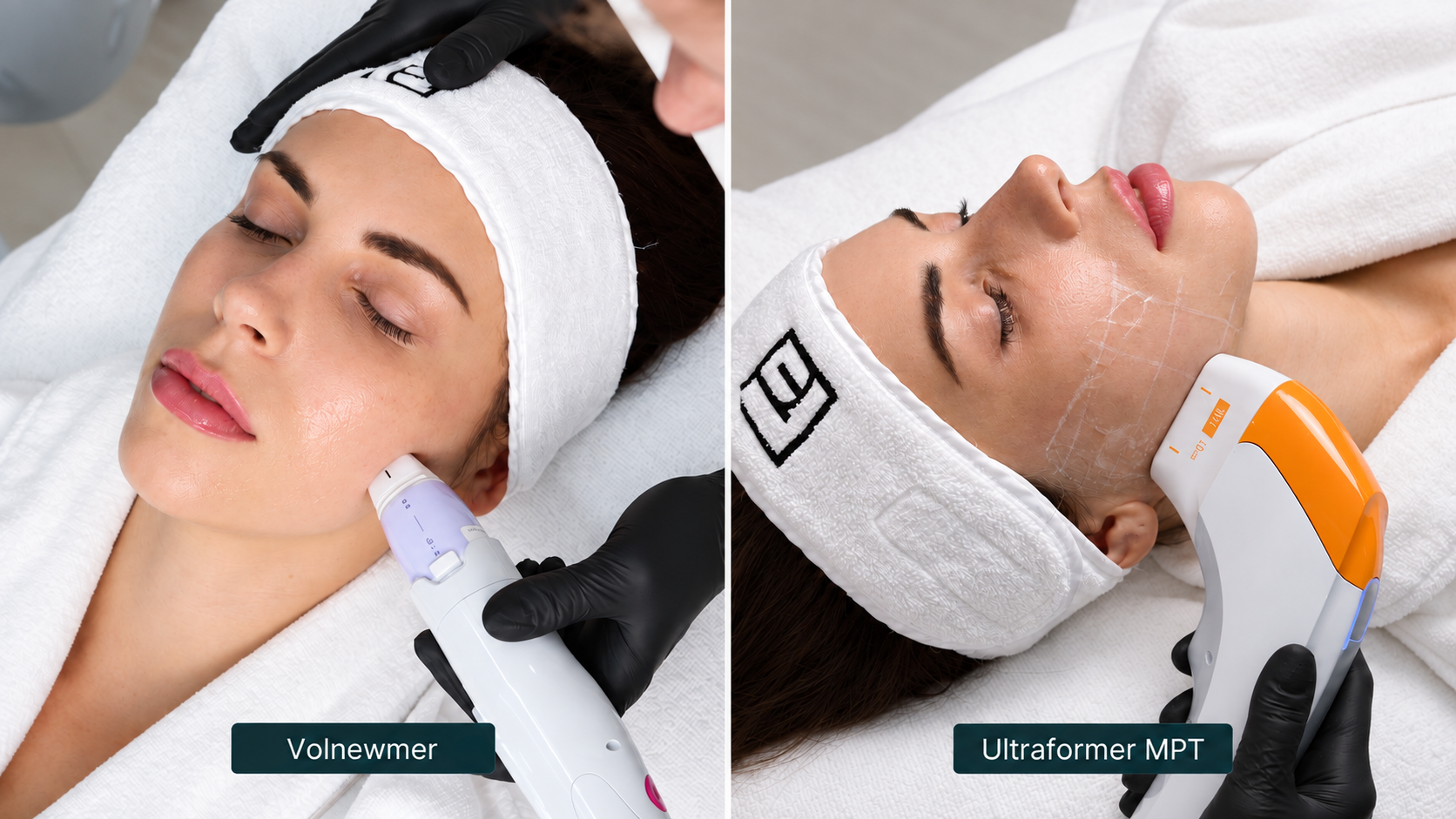
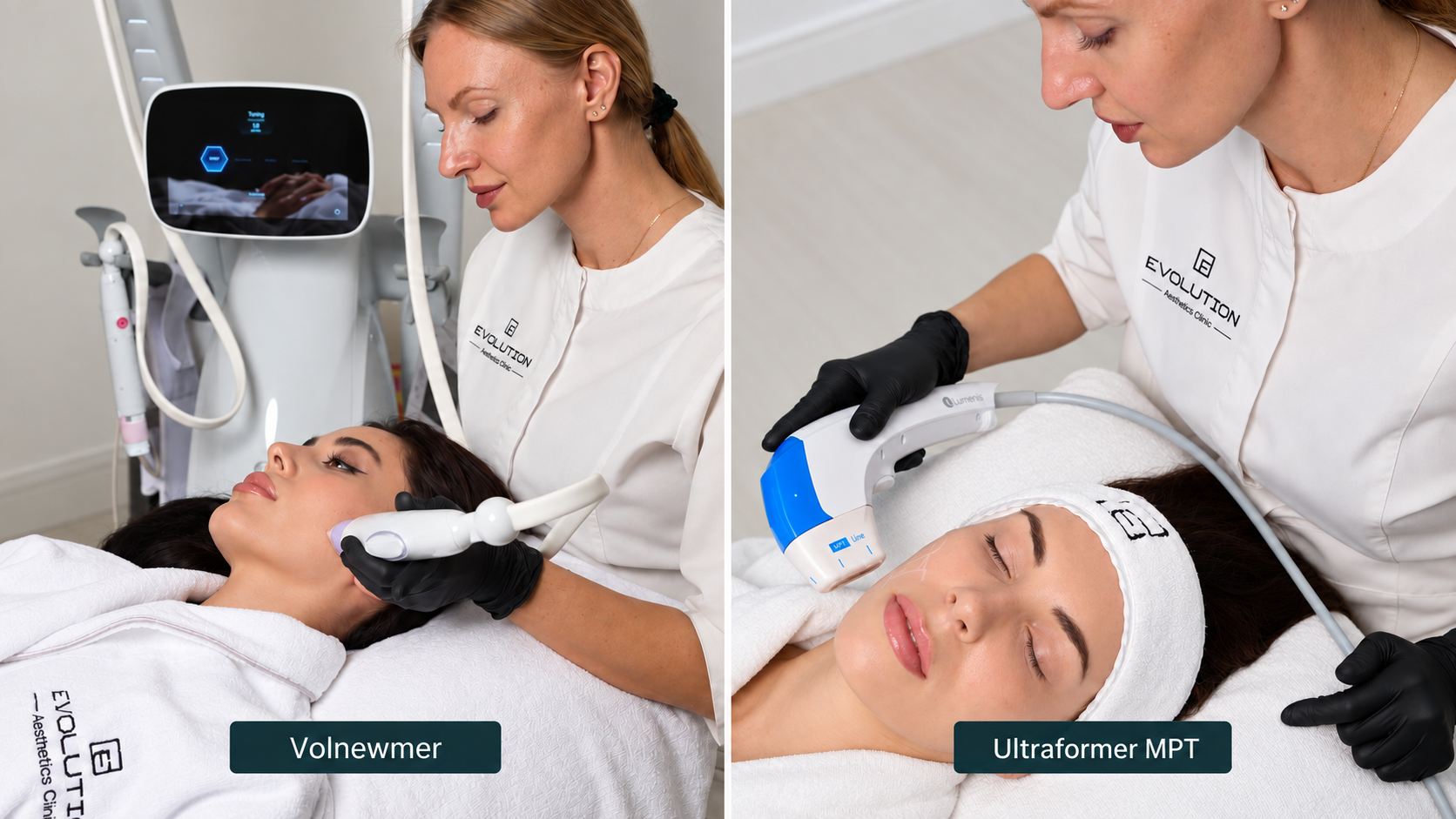
Volformer combines Volnewmer monopolar radiofrequency with Ultraformer MPT focused ultrasound. This gives your doctor two complementary ways to plan treatment across relevant facial layers: broader RF heating for dermal firmness and ultrasound focused at selected depths.
At Evolution Aesthetics Clinic in Dubai, the aim is a personalised plan for firmer-looking skin and improved definition, while respecting your facial volume and proportions. Here is how that approach differs from RF-only options such as XERF.
XERF, Volnewmer and Volformer: the key differences
| Treatment | Energy technology | How treatment is personalised |
|---|---|---|
| XERF | Monopolar RF at 2 MHz and 6.78 MHz | RF depth settings, intensity and coverage |
| Volnewmer | Monopolar RF at 6.78 MHz | Applicator size, energy, cooling and treatment coverage |
| Volformer | Volnewmer RF plus Ultraformer MPT focused ultrasound | RF settings and coverage, plus separately selected ultrasound depths and treatment patterns |
XERF uses two frequencies within one energy modality: radiofrequency. Its manufacturer describes three depth settings and cryogen cooling. Volnewmer uses continuous contact water cooling and different tip sizes. XERF specifications and Volnewmer specifications.
Volformer adds a different modality—focused ultrasound—to the treatment plan. That distinction matters when the assessment identifies a useful role for both dermal heating and depth-specific ultrasound.
Why facial rejuvenation needs a layered approach
The face changes at several levels. The dermis contributes strength and elasticity; fat compartments and connective tissue help create shape and volume; deeper supporting structures, including the superficial musculoaponeurotic system (SMAS), help organise the tissues above them.
These structures vary across the face. The forehead, cheeks and jawline do not have identical skin thickness or tissue depth. A treatment plan therefore needs to consider both the area and the tissue being targeted.
Ultraformer MPT research documents these anatomical differences. A cartridge’s depth is a focal setting, rather than a universal map of a facial layer. Ultraformer MPT anatomical study.
Volformer’s treatment philosophy is to address every relevant layer for your face, with an appropriate method for each.
Ultraformer MPT: which depths and layers do the cartridges target?
Ultraformer MPT delivers focused ultrasound at selected depths. Its standard facial cartridges offer 1.5, 2.0, 3.0 and 4.5 mm focal settings.
| Nominal focal depth | Relevant tissue level, depending on anatomy | Treatment-planning role |
|---|---|---|
| 1.5 mm | Usually within the dermis | A shallower target for skin tightening |
| 2.0 mm | Dermal tissue or the dermal–subcutaneous boundary | An intermediate option between 1.5 and 3.0 mm |
| 3.0 mm | Deep dermal or subdermal tissue, including connective tissue in the superficial fat layer | Selected intermediate targets for tightening and contour planning |
| 4.5 mm | Deeper supporting tissue, potentially including the SMAS | A deeper target for the lifting component where anatomy permits |
Your doctor chooses the appropriate depths and zones after assessment. A 4.5 mm cartridge does not automatically reach the SMAS in every area. Preserving facial volume and avoiding vulnerable structures are part of this planning. Anatomical findings.
Ultra Booster: 1.5, 3.0 and 4.5 mm
The three Booster cartridges use a circular delivery pattern at 1.5, 3.0 and 4.5 mm. Standard F-type cartridges use a linear pattern. This adds a choice of delivery pattern at the same nominal focal depths.
Body cartridges: 6.0, 9.0 and 13.0 mm
The manufacturer lists 6.0, 9.0 and 13.0 mm cartridges for body treatment. These deeper targets are intended for suitable body tissue and are not additional routine facial layers.
Together, the four facial, three Booster and three body cartridges make up the platform’s ten-cartridge range. CLASSYS Ultraformer MPT specifications.
Volnewmer: four tips for targeted RF coverage
Volnewmer uses 6.78 MHz monopolar RF. CLASSYS describes its dermal targets as the papillary and reticular layers—the upper and deeper parts of the dermis. Continuous water cooling helps protect the skin surface.
| Applicator | Contact area | Intended treatment area |
|---|---|---|
| I Tip | 0.25 cm² | Small, precise areas, including suitable areas around the eyes |
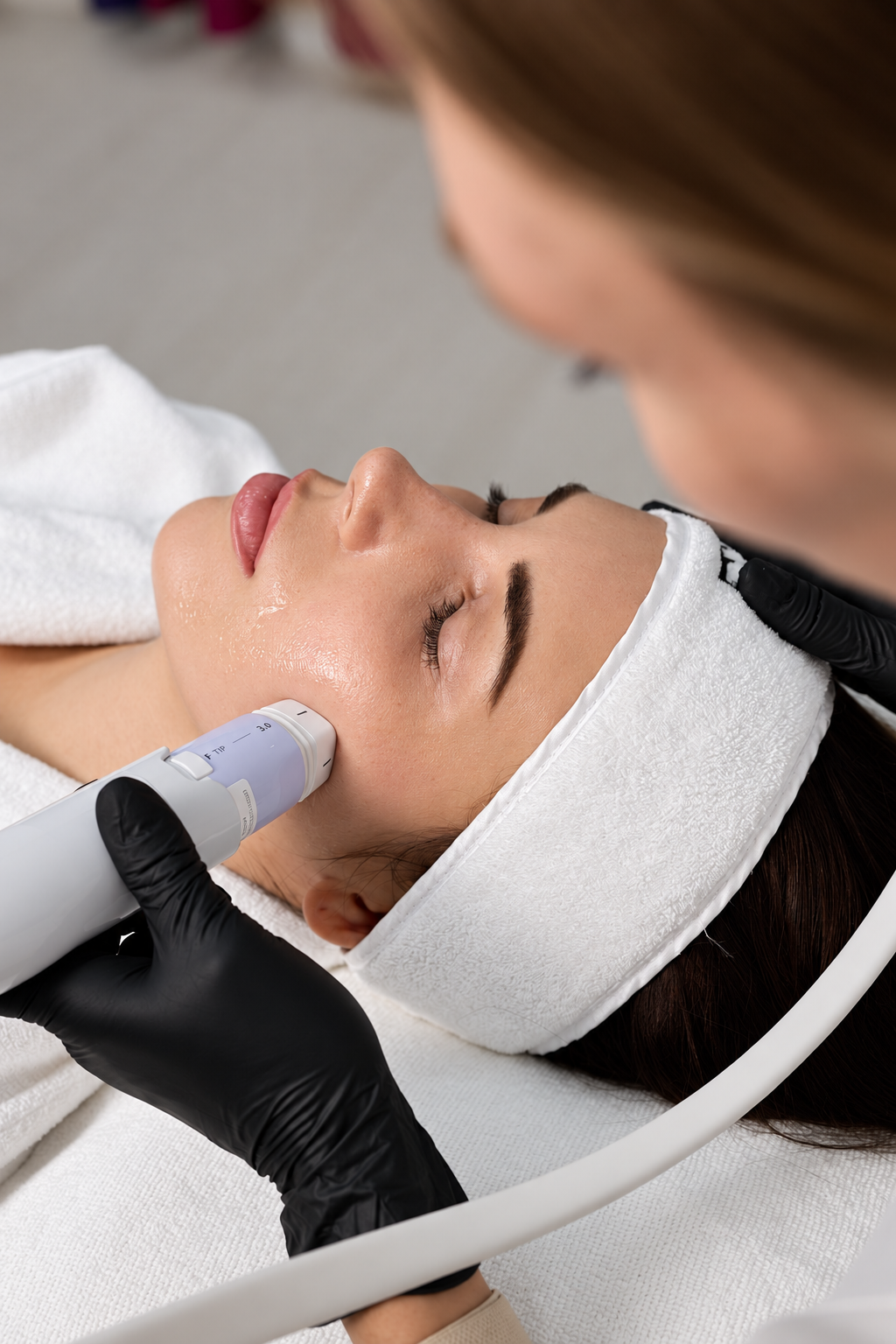
| F Tip | 3.0 cm² | Facial contouring, including the chin and jawline |
| V Tip | 4.0 cm² | Broader facial tightening |
| S Tip | 16.0 cm² | Body areas |
These figures describe surface area, not penetration depth. Volnewmer’s tips do not correspond to four fixed depths in millimetres. RF heating varies with the applicator, settings, cooling and tissue properties. CLASSYS Volnewmer information.
RF frequency and ultrasound focal depth are also different measurements. Comparing 2 MHz, 6.78 MHz and 4.5 mm cannot establish which treatment will produce the best result for a particular face.
What does combining RF and ultrasound add?
The useful advantage of a combined protocol is the additional choice it gives the clinician.
Where skin laxity and changes in deeper support occur together, the doctor can plan ultrasound targets separately from RF coverage. Where existing facial volume needs particular care, ultrasound can be limited or excluded in selected zones.
This allows a coordinated approach to several concerns:
- Skin firmness: a dermal treatment component using Volnewmer RF.
- Selected deeper targets: an ultrasound component with cartridge depths chosen for local anatomy.
- Facial balance: different treatment decisions for different areas, guided by the volume and proportions to preserve.
The two devices are used in separate, planned steps. Suitable patients may receive both within one appointment.
Explore our Volformer face lifting treatment in Dubai for the consultation and treatment process.
When is Volformer worth considering as a XERF alternative?
If you are comparing XERF with Volformer, consider whether your treatment goals would benefit from two complementary energy modalities.
XERF offers several depths within an RF-based approach. Volformer allows the clinician to select both the ultrasound focal depth and the RF treatment coverage independently. When both methods are appropriate, that adds another dimension to personalisation.
For a patient seeking attention to skin firmness and selected deeper tissue targets, this is a practical reason to explore Volformer. The clinical rationale for combining technologies does not establish better results for everyone. The choice depends on anatomy, clinical assessment and the outcome being sought.
If RF alone fits the concern, Volnewmer skin tightening may be sufficient. Our Volnewmer vs HIFU guide explains how the two technologies differ.
What does the clinical evidence show?
Volnewmer has published human studies. One retrospective study assessed 30 women with three-dimensional imaging after treatment. It reported short-term changes, but had one-month follow-up and no untreated or XERF comparison group. It cannot establish superiority or long-term duration. Read the original Volnewmer study.
A study of 24 Korean adults tested the order of same-day Volnewmer and CLASSYS focused ultrasound treatment, with 90-day follow-up. It used Shurink Universe, rather than the Ultraformer MPT in our clinic protocol. It compared treatment sequences, not the combination against XERF or either device alone. It therefore does not prove that two devices outperform one. See the 2025 combination study.
XERF also has human evidence, including a retrospective report of 16 patients with three-month follow-up. Small studies with different methods cannot provide a reliable ranking between devices. See the 2026 XERF study.
Comfort, recovery and choosing a suitable plan
Cooling does not make treatment sensation-free. We explain expected discomfort, possible reactions and material risks before consent. Heat-based treatment can cause redness, swelling or tenderness; burns and unwanted tissue injury are also risks. Ultrasound can also cause altered sensation, nerve symptoms or unwanted fat loss. We defer elective treatment during pregnancy and breastfeeding. Electronic implants, active skin infection and poor healing can make treatment unsuitable. Tell us about medicines, implants and recent aesthetic treatments so we can assess suitability and timing.
We provide written aftercare and a route for follow-up. Read our Volnewmer side effects and aftercare guide. For expectations over time, read how long Volnewmer results last. Neither treatment comes with a guaranteed result or duration.
Frequently asked questions
Is Volformer better than XERF?
Volformer offers RF and focused ultrasound within one personalised protocol. That creates additional treatment-planning options when both are indicated. Direct comparative evidence has not established that it produces better results than XERF for every patient.
Does Volformer treat all facial depths?
It offers a range of options for selected dermal and deeper targets. Your doctor chooses the layers relevant to your face; using every cartridge is not the goal.
Is XERF a single-frequency treatment?
No. XERF combines 2 MHz and 6.78 MHz. Both are radiofrequency, so it remains one energy modality. Volformer combines RF with focused ultrasound.
Do Volnewmer tips have fixed depths?
No. I, F, V and S tips have different contact areas and intended treatment zones. Their sizes are measured in square centimetres, not millimetres of penetration.
Can the combination improve jawline definition?
Jawline definition can be a treatment goal when laxity contributes to the concern. Your doctor assesses skin, tissue support and volume to determine whether a combined approach is suitable.
Choose a plan built around your face
A refreshed appearance depends on how skin quality, support and contours work together. At Evolution Aesthetics Clinic in Dubai, we assess these elements before selecting the technologies, areas and depths for your treatment.
Book a consultation to explore Volnewmer or a combined Volformer protocol, with a personalised plan for the layers that matter to your result.