

01
5 sessions
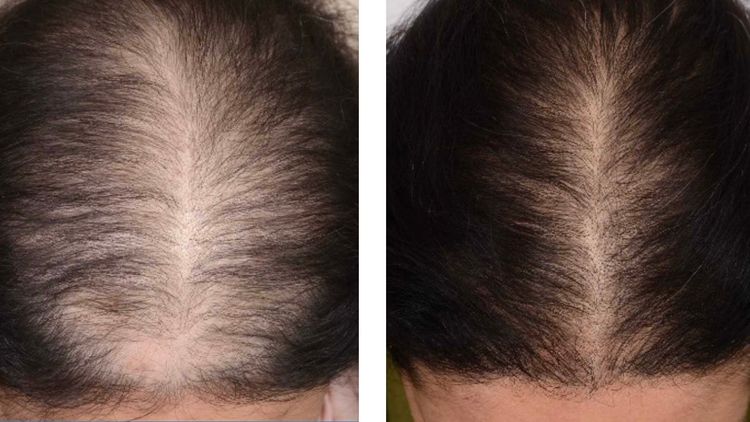
Narrower-looking part line with denser hair coverage.
Evolution Aesthetics Clinic
Eclipse PRP system
We draw one tube of your blood and spin it once in the Eclipse tube. Its separator gel keeps the platelets and plasma and removes 99% of the red blood cells, leaving a clear platelet-rich plasma.
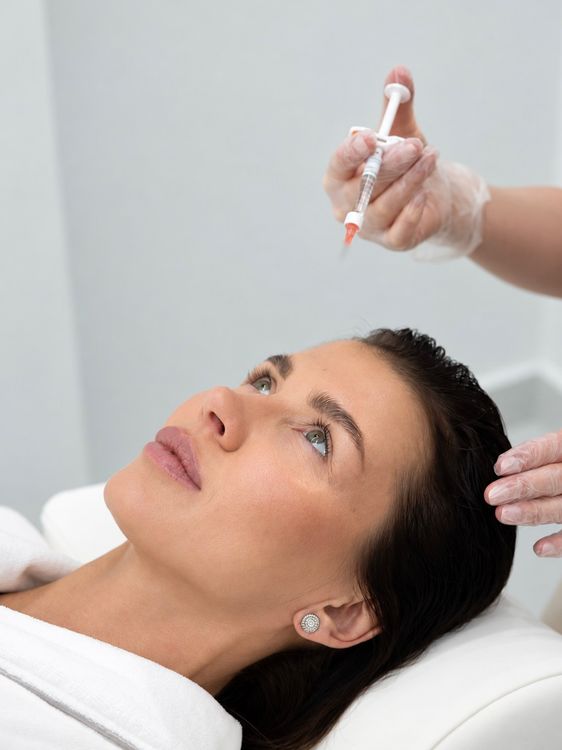
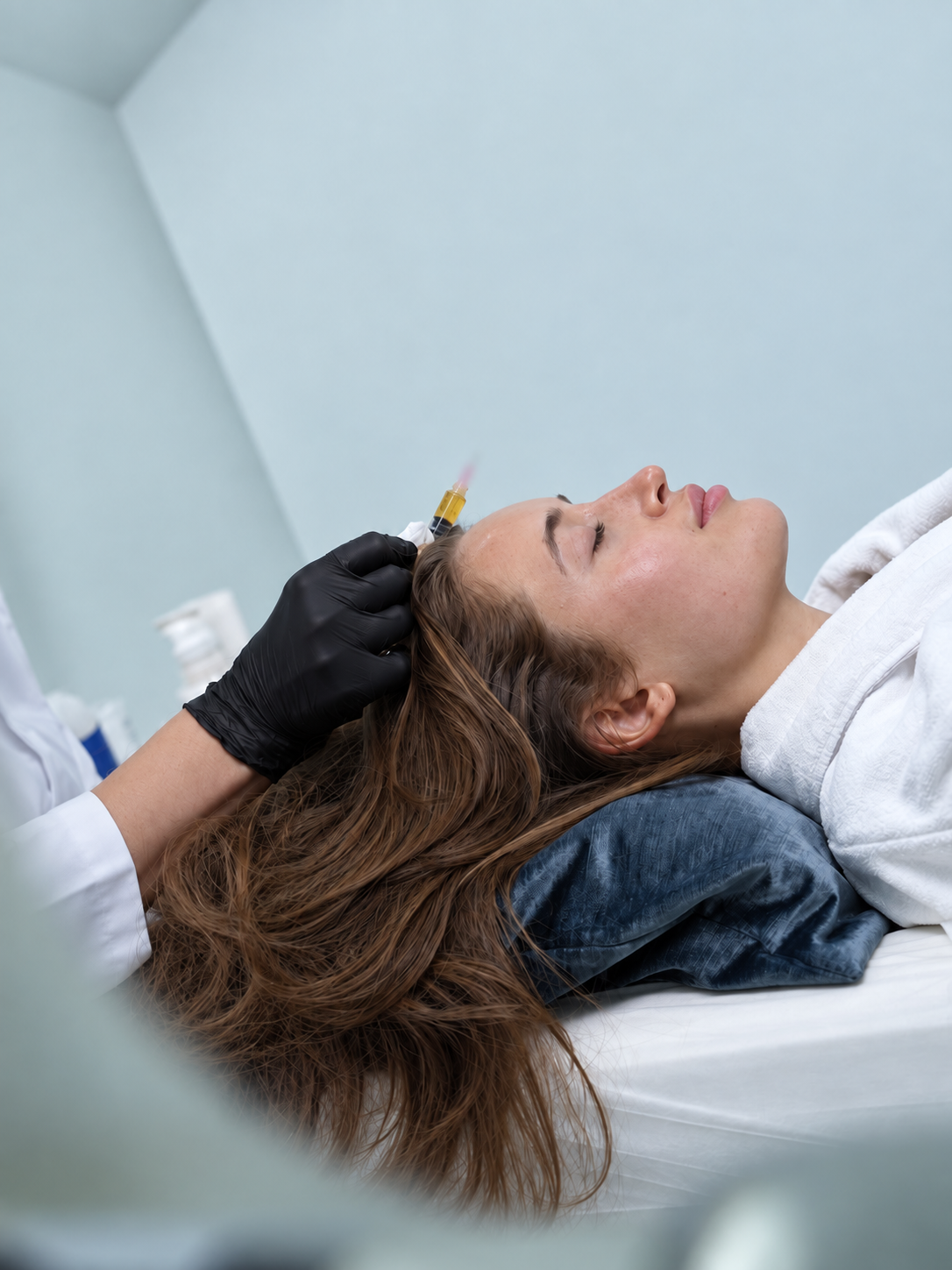
Your doctor injects that plasma into the thinning scalp with a fine needle, a few millimetres deep, where the hair follicles sit. Platelets release growth factors that lengthen the growth phase of weak follicles and improve blood supply around them.
PRP thickens hair that still grows. It cannot restart a follicle that has been dead for years.
key facts
PRP works on follicles that are shrinking, not on follicles that are gone. The pattern and stage of your hair loss decide the answer.
Your appointment
The visit takes 45 to 60 minutes. A nurse draws 15 ml of blood from your arm and the Eclipse tube spins for about 10 minutes while numbing cream works on your scalp.
Your doctor then places a series of small injections across the thinning area, a few millimetres deep. Most people feel pressure and short stings; the crown and hairline are the most sensitive spots.
The scalp is pink and tender for a few hours. You drive home, work the same day and wash your hair the next morning.
Real results
Both patients below completed 5 sessions. The photographs show the same parting under the same light; your pattern, age and hormones decide how close your result comes to theirs.
Individual results may vary.
Narrower-looking part line with denser hair coverage.
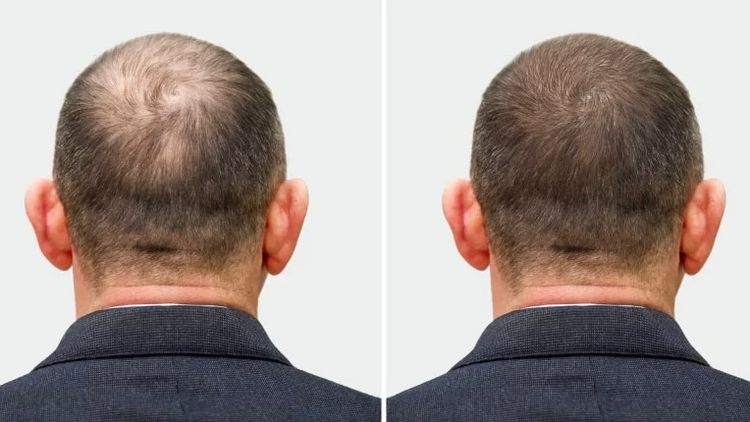
Fuller-looking coverage and less visible scalp.
Questions
Three sessions 4 to 6 weeks apart is the starting course, the same schedule the controlled trials used. Shedding usually eases between the first and second session. Density is judged on photographs 6 months after the first session. If you responded, one maintenance session every 3 to 6 months keeps the gain; if nothing changed by month 6, we stop PRP and change the plan.
For patterned hair loss, partly. In a 25-patient half-head trial, the PRP side had higher hair density than the untreated side at 6 months. In a 35-patient trial, density rose by about 20 hairs per square centimetre on the PRP side, but the saline side improved too and the difference was not significant.
Numbing cream sits on the scalp for 20 minutes before the injections. You feel pressure and quick stings, sharpest at the hairline and crown, for about 10 minutes. The scalp aches like mild sunburn for the rest of the day. Paracetamol is fine; ibuprofen is not, because it blunts the platelets.
Both aim at thinning follicles. PRP has more than a decade of controlled trial data; exosome evidence is newer and smaller. We choose one after examining your scalp, and some plans combine them.
Yes, and we recommend it when you already respond to it. Skip minoxidil on the day of the session and restart 24 to 48 hours later. Minoxidil keeps follicles in the growth phase; PRP thickens the hair they make. Stopping minoxidil reverses its benefit within months, so PRP is not a way to quit it.
Yes. Female pattern hair loss, a widening parting with a preserved hairline, responds to PRP in the same way as male pattern loss. Women lose hair more often from low iron, thyroid disease and the months after childbirth, so we test for these first; PRP does not fix a deficiency. We do not treat during pregnancy or breastfeeding.
Treatment guides
Three guides: what to expect after the injections and how to care for your scalp, how to judge PRP results month by month, and how PRP and minoxidil fit in one plan.
PRP and minoxidil are different options for some forms of hair loss. The useful question is which plan fits your diagnosis, health and routine, rather than which name is more popular.
PRP hair results should be assessed over months, not from the appearance of the scalp immediately after injections. Reduced shedding and a visible change in density are different outcomes, and neither is guaranteed.
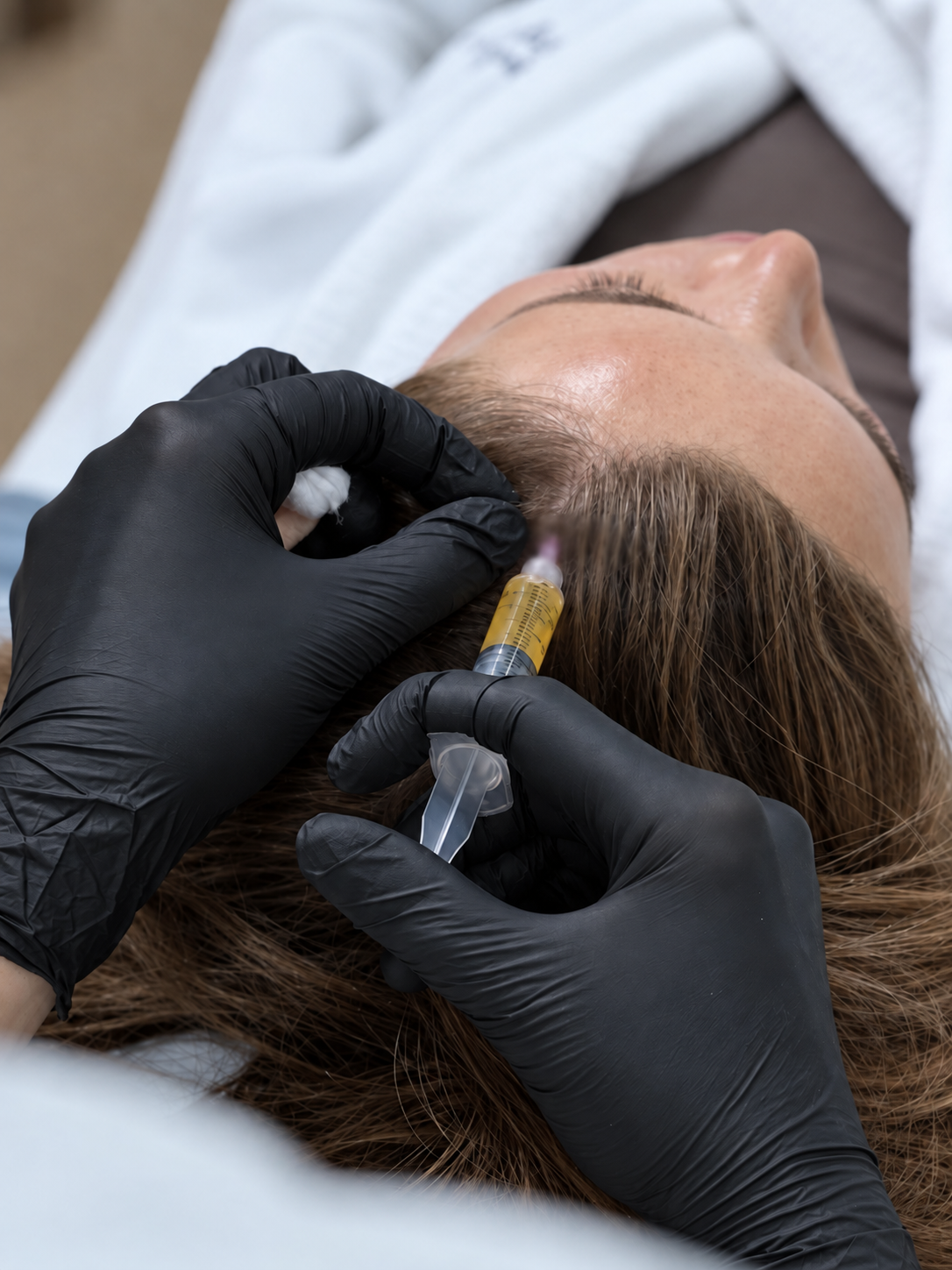
PRP hair treatment uses your own blood, but the blood draw and scalp injections still have risks. We review your scalp, medical history and medicines before recommending a course.
Dr Yulia Krasnaya and Dr Vera Nikulina perform PRP scalp injections at Evolution Clinic. Both are DHA-licensed and examine the scalp themselves before recommending a course.

Specialist Dermatologist
Medical Director of Evolution Clinic, Specialist Dermatologist from Russia, M.D., Official Trainer for Laser Technologies. DHA License 03624607-001
Meet Yulia
General Practitioner
General Practitioner at Evolution Aesthetics Clinic in Dubai. DHA License 39929792-001.
Meet VeraPatterned hair loss is the reason for most PRP hair sessions we perform. In men it starts at the temples and crown; in women it shows as a widening central parting while the front hairline stays. The follicles are not dead. Under the influence of dihydrotestosterone they shrink with each cycle, produce a finer and shorter hair, and spend longer resting. PRP targets exactly this stage: the growth factors from your platelets push shrinking follicles back into a longer growth phase and improve the small blood vessels that feed them.
The best results come from areas that still have fine hair. A crown that looks thin under bright light responds; a smooth patch that has been bare for five years does not, because there is nothing left to stimulate. This is why we ask you to send a photo before you book.
Telogen effluvium is different. A fever, surgery, childbirth, crash dieting or low iron pushes a large share of follicles into the resting phase at once, and 2 to 3 months later handfuls of hair come out in the shower. The follicles are healthy and the hair regrows on its own over the following months once the cause is corrected. PRP has no role here; a blood test for ferritin, thyroid function and vitamin D does. We book those through our laboratory tests and treat the cause first.
Round, completely smooth bald patches are usually alopecia areata, an autoimmune condition treated with steroid injections or other medicine, not PRP. Scarring alopecias such as lichen planopilaris destroy the follicle and leave shiny skin; PRP cannot rebuild a follicle that has been replaced by scar. Both need a dermatologist's diagnosis, sometimes a scalp biopsy, and we refer rather than inject.
Shedding drops first, usually between weeks 4 and 8. Hairs in the treated area then grow thicker and longer over months 3 to 6, so the parting looks narrower and the scalp shows less under light. Two published controlled trials measured this: the 2016 half-head trial found higher hair density on the PRP side at 6 months, and the 2020 split-scalp trial measured a gain of about 20 hairs per square centimetre, although its saline side also improved. Nobody in either trial regrew a bald area. Our two before-and-after cases above each had 5 sessions.
Genetic thinning continues after the course, so without maintenance the gain fades, which is why we book one session every 3 to 6 months for patients who responded. Our guide on assessing PRP results over time explains how to photograph your parting so that you can see the change yourself.
Eclipse PRP is made by Crown Aesthetics in the United States and holds FDA 510(k) clearance for preparing platelet-rich plasma from a patient's own blood. The tube contains a separator gel: after one spin of about 10 minutes the red blood cells sit below the gel and the platelet-rich plasma above it, so the plasma we inject contains almost no red cells, which are the main cause of post-injection soreness and inflammation. The 15 ml tube gives about 7 ml of PRP, enough for the parting and crown in one session. We buy the tubes from the official UAE distributor and can show you the paperwork.
Minoxidil and finasteride are the two medicines with the strongest evidence for patterned hair loss. Minoxidil keeps follicles in their growth phase and shows its effect after 6 to 12 months of daily use; finasteride blocks dihydrotestosterone in men and takes about 4 months to show. Both stop working when you stop them. PRP works on the same follicles from a different direction and is often combined with them. If you already use minoxidil and it is holding, we keep it; if you want to avoid daily medicine, PRP alone is a reasonable trial with a decision point at 6 months. Our guide on PRP or minoxidil sets out the trade-offs.
Exosomes for hair loss deliver a laboratory-prepared vial of cell-derived vesicles rather than your own platelets. Exosomes need no blood draw and the vial has a fixed concentration, while PRP quality depends on your platelet count on the day. PRP has more than a decade of controlled trial data; exosome trials are fewer and smaller. We choose between them on your scalp findings and budget, and some patients alternate the two.
Dermadrop scalp treatment pushes a nutrient solution into the scalp without needles and suits patients who cannot have injections. HELEO4 scalp treatment uses photodynamic light to reduce scalp inflammation and oiliness. None of these replaces PRP for patterned thinning, and any of them can be added between PRP sessions.
The same Eclipse tube is used for PRP facial treatment, where the plasma is injected into the skin for texture and glow.
Drink water normally for 24 hours before; a dehydrated sample gives less plasma. Eat a light meal 1 to 2 hours before so that the blood draw does not make you faint. Avoid alcohol for 24 hours and stop ibuprofen, naproxen, aspirin for pain and other anti-inflammatory tablets 3 to 5 days before, because they reduce platelet activity. Do not stop aspirin or any blood thinner that a doctor prescribed for your heart or circulation; tell us instead and we decide with your prescriber whether PRP is suitable. Come with clean, dry hair and no styling products, and skip minoxidil on the day.
Do not wash the scalp for 12 to 24 hours. Skip the gym, sauna, swimming and hot yoga for 24 hours, and hair dye, bleach or keratin treatment for 72 hours. Avoid anti-inflammatory tablets for 3 days; paracetamol is fine for the ache. Restart minoxidil after 24 to 48 hours. Sleep is normal; a pillow does not disturb the injections. Our side effects and aftercare guide covers the first week in detail.
Expected: tenderness, mild swelling and pinpoint bleeding at injection points for a day, sometimes small bruises on the scalp or at the blood-draw site for a week. A temporary increase in shedding in weeks 2 to 3, as weak hairs are pushed out by new growth, happens to some patients and settles. Uncommon: headache on the day, and light-headedness during the blood draw. Rare: infection at an injection site, which shows as spreading redness, pus or fever within a few days. Contact us on WhatsApp the same day if that happens. PRP uses only your own blood, so allergic reaction to the plasma itself does not occur; the numbing cream can cause a reaction in people allergic to lidocaine, so tell us about anaesthetic allergies.
Evolution Aesthetics Clinic holds DHA Polyclinic License 6000514. Dr Yulia Krasnaya and Dr Vera Nikulina are DHA-licensed and inject within their approved scope. The Eclipse tubes are original, single-use and bought from the official UAE distributor; the paperwork is available on request. You leave with written aftercare and a WhatsApp route to the clinic, open every day from 9:00 to 21:00.
Questions
The next morning, 12 to 24 hours after the session, with lukewarm water and your usual shampoo. Rub gently rather than scratch. Keep hair dye, bleach and keratin or straightening treatments off the scalp for 72 hours, because the injection points are still open to chemicals.
Wait 24 hours. Sweat, heat and a raised heart rate increase swelling and bleeding at the injection points, so the gym, running, sauna, steam room and swimming pool all wait until the next day. Walking is fine straight away.
Some patients notice extra shedding in weeks 2 to 3 after a session. Follicles that were about to shed their old, thin hair release it sooner as the new growth phase starts. It settles by week 4 to 6. Shedding that keeps rising, or hair loss in a new area, needs a review, so send us a photo.
Not for typical patterned thinning in a healthy adult. We order ferritin, thyroid function, vitamin D and, in women with irregular periods or chin hair, hormone tests when the pattern or history points to another cause. Correcting low iron often stops shedding on its own; we do not inject PRP over an untreated deficiency.
Related reading
Our other hair-loss treatments and the medical references behind this page.
