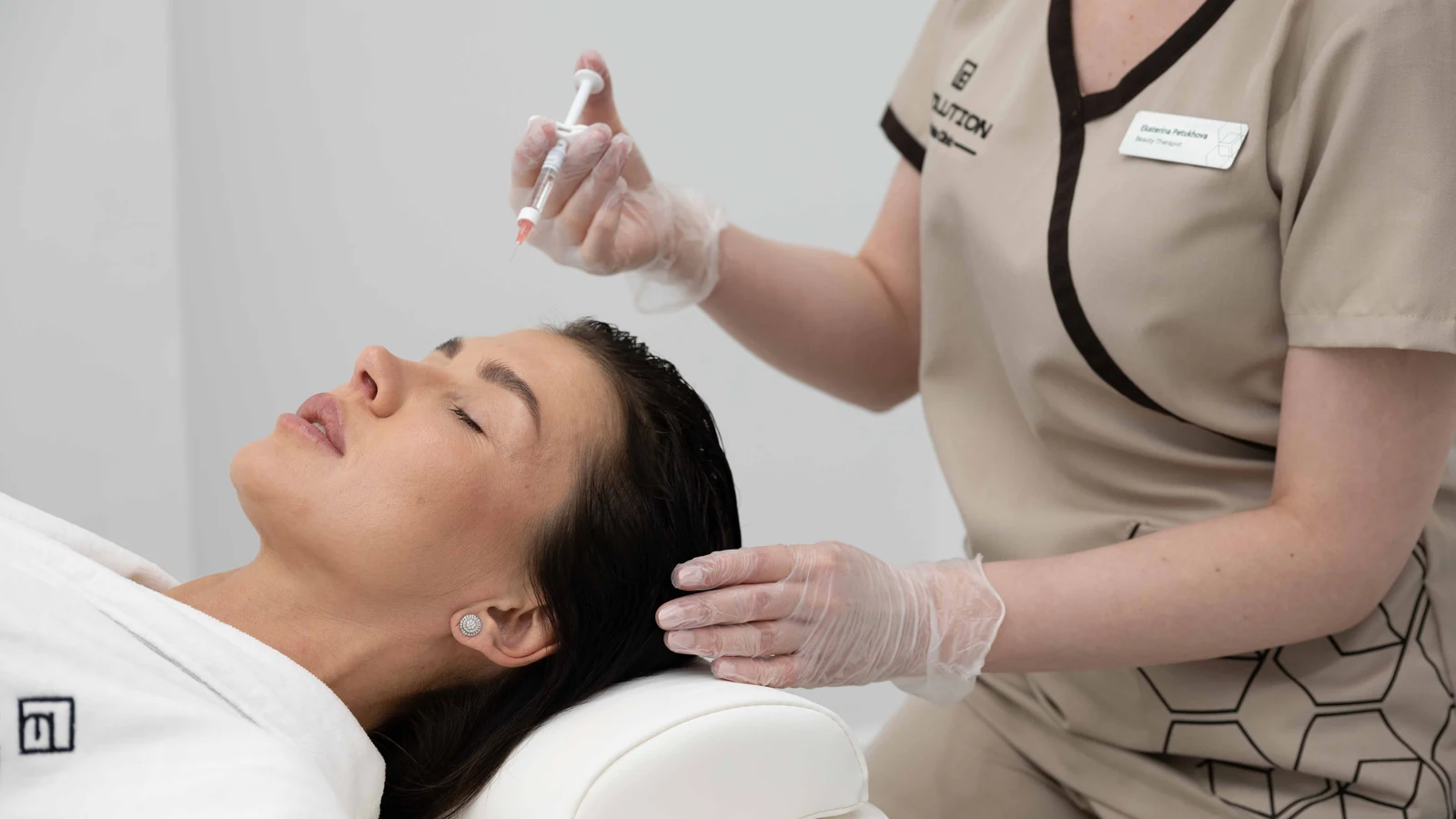
Botox for facial expression lines often lasts about three to four months. The effect develops over several days and gradually wears off. Some people notice changes sooner or keep a result longer, so a treatment date cannot give you an exact result date or expiry date. The American Academy of Dermatology gives this typical range.
At Evolution Clinic, we discuss timing for the area and product in your plan. We also explain when to contact us and when to review the result. For treatment areas and booking, see our Botox page.
How long does Botox take to work?
Many people notice less movement in the treated muscles within three to seven days. Some notice it earlier. A smoother appearance can develop as that movement changes; it is not an immediate filling effect.
Botox does not replace lost facial volume. A line visible when your face is at rest may also involve changes in the skin, so less movement does not mean the line will disappear completely. Our doctor checks this before recommending treatment.
The exact timeline depends on what was treated and how the result is measured. For upper-face lines, the official BOTOX Cosmetic patient information describes possible first changes in one to two days and full results at 30 days. That is why “nothing happened on day one” is not a reliable way to judge the outcome.
What should I expect during the first month?
The first few days
There may be small injection marks, tenderness, redness or bruising while the treatment effect is still developing. Follow your written aftercare and contact us if symptoms worry you. A visible mark immediately after injection is not the final wrinkle result.
Around two weeks
This can be a useful point to review movement, symmetry and your response. It is not a universal deadline by which every area must have reached its final result. We agree the review timing for your treatment and assess a concern earlier if needed.
By the first month
We can compare the result with the starting point and discuss any remaining concern. The manufacturer’s upper-face timeline extends to 30 days. Do not arrange extra injections simply because one area seems slower to change. A review must consider the product, dose already given and time since treatment.
For what to do during this period, read our Botox preparation and aftercare guide.
How can I tell when Botox is wearing off?
Look for the gradual return of movement in the treated area. Compare the same expression, camera angle and lighting with your earlier photos. The first small movement does not mean that the entire effect has ended. A photograph with raised eyebrows cannot be compared fairly with one taken at rest.
Record when movement returns and when the result no longer meets your goal. These may be different dates. Bring both observations to the review so we can discuss the response without using an arbitrary expiry date.
Why does Botox last longer for some people?
The product, dose, muscles treated and your individual response can affect the result. Previous treatment also gives the doctor useful information about how you respond. The label for BOTOX Cosmetic describes an approximate three-to-four-month effect for frown lines; it does not promise that duration for every person or every use.
It also helps to define what “lasting” means. The first return of some movement is different from a complete return to your starting appearance. A photograph at rest and one during the same expression can answer different questions.
Tell us what you noticed after a previous treatment: when change began, how long you were satisfied and whether any unwanted effect occurred. A record of the exact product and treatment date is more useful than a remembered unit count alone.
Do all areas follow the same timeline?
No. Forehead lines, frown lines and crow’s feet are common cosmetic uses, but jaw muscles, trapezius muscles, sweating and medical headache treatment involve different goals. Do not use the wrinkle timeline to predict a body-contour change or a medical response.
We explain the expected course for the proposed area during your assessment. Where the evidence is less certain, the expected limits should be part of that discussion. An all-purpose promise that Botox “lasts six months everywhere” is not a sound basis for planning.
Does Dysport or Xeomin last longer than Botox?
There is no reliable single answer for every patient and area. Studies use different products, doses and definitions of response. A result reported at five months in one study does not mean every person will prefer that product or obtain that duration.
Units are specific to the product, so the same number of units is not a direct comparison. We explain the product choice as part of your treatment plan. Our Dysport versus Botox guide covers the comparison in more detail.
When can I have Botox again?
Arrange a review when you want to discuss the returning movement or another concern. The doctor considers the benefit, risks and interval for the actual product. More frequent treatment is not automatically better. Product instructions commonly set minimum intervals; the BOTOX Cosmetic label does not establish the safety and effectiveness of cosmetic use more often than every three months.
If the result seems short, contact us before assuming that you have become resistant. A reduced response has more than one possible explanation. Do not use supplements or an extra dose as a self-directed way to extend it.
If you are planning an important event, speak to us well in advance. Allow time for the effect to develop, for visible injection effects to settle and for a review if required. We can discuss a suitable appointment date after assessment.