

01
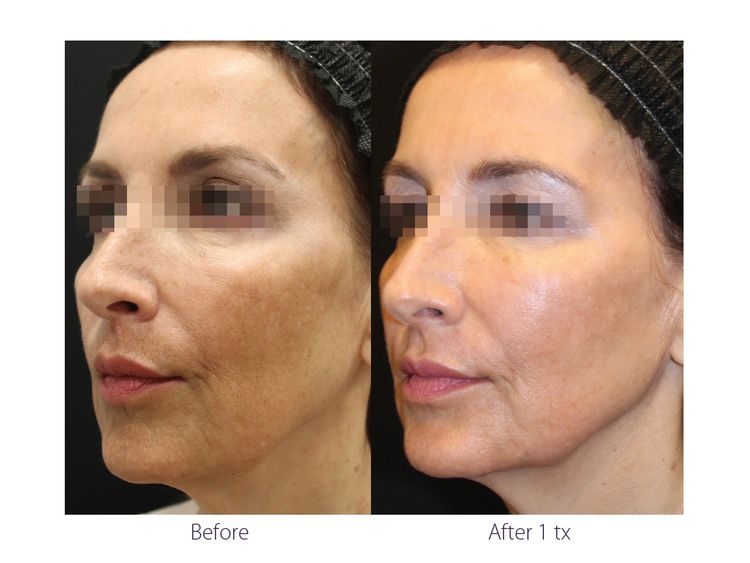
1 session
More even-looking pigmentation and a brighter complexion.
Evolution Aesthetics Clinic
Sun spots and age spots
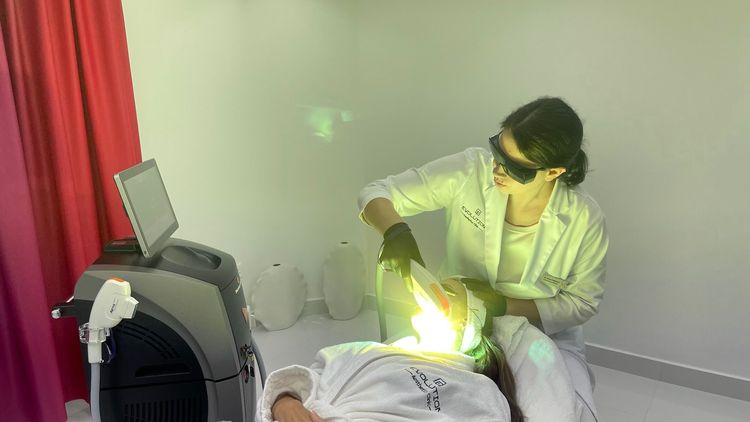
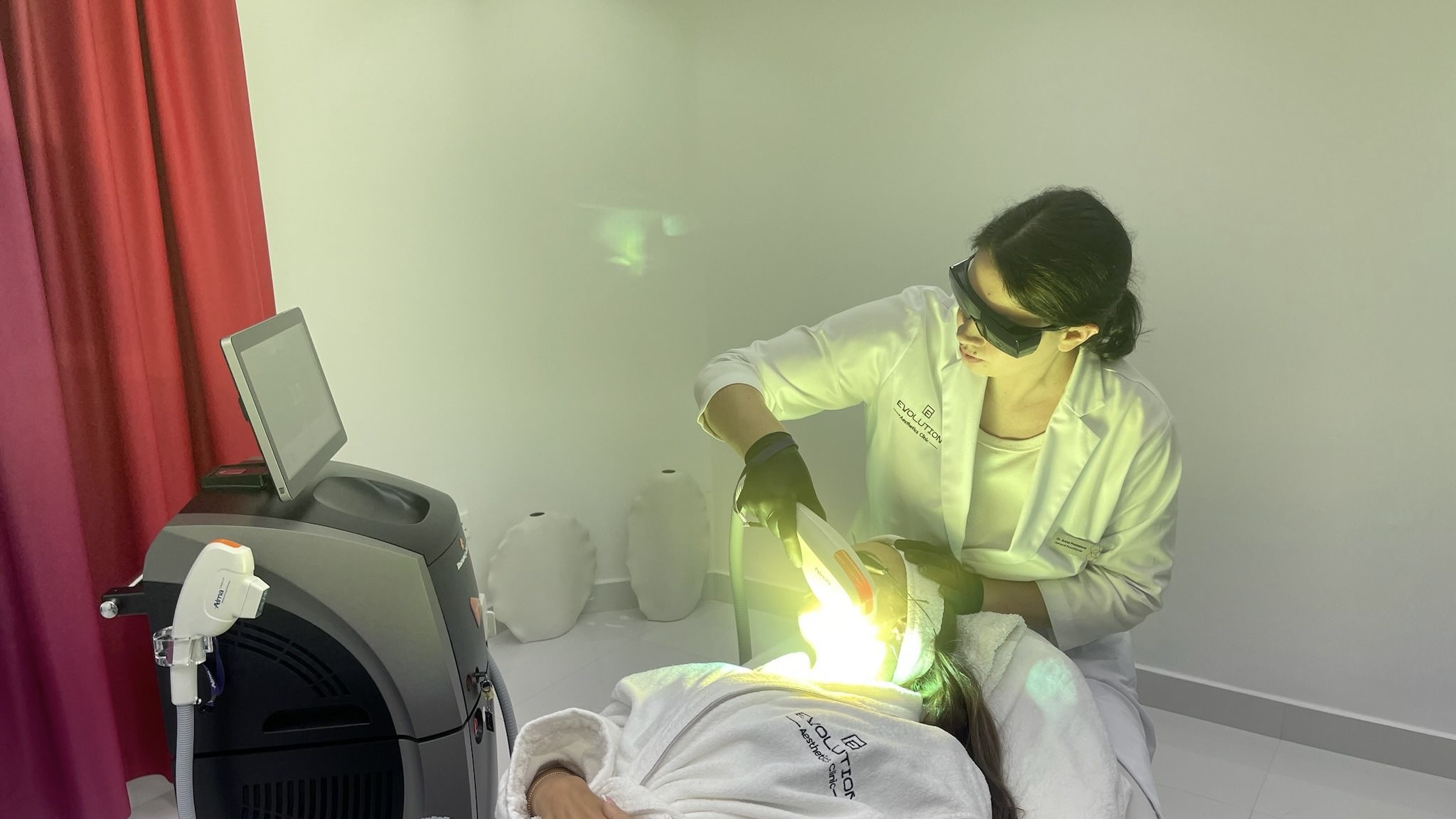
The Dye-VL applicator on our Alma Harmony XL Pro sends a filtered band of light, 500 to 600 nm, into the skin. Melanin in a sun spot absorbs it and heats; the spot darkens, forms a fine crust and flakes away over one to three weeks.
IPL suits flat brown marks made by the sun: solar lentigines, freckles and age spots on the face, hands and décolletage. It does not remove moles, treat melasma reliably or work equally on every skin tone.
Our specialist dermatologists confirm the type of pigmentation before any light is used.
key facts
A consultation tells us whether your marks are sun damage, melasma or post-inflammatory darkening. Each responds differently to light.

Your appointment
We examine your spots under magnification, ask about sun exposure, medicines and previous pigmentation treatments, and photograph the area. On darker skin we may treat a test spot first.
If you go ahead, we cleanse the skin, apply cooling gel and fit protective eyewear. The applicator delivers cooled pulses; each feels like a brief snap of heat. A face session usually takes about 20 to 30 minutes.
You leave with written aftercare and can usually return to work the same day. The spots look darker for several days before they flake.
Real results
These photographs show individual patients after one session. Sun-induced spots respond best; your result depends on pigment type, skin tone and sun protection afterwards.
Individual results may vary.
More even-looking pigmentation and a brighter complexion.
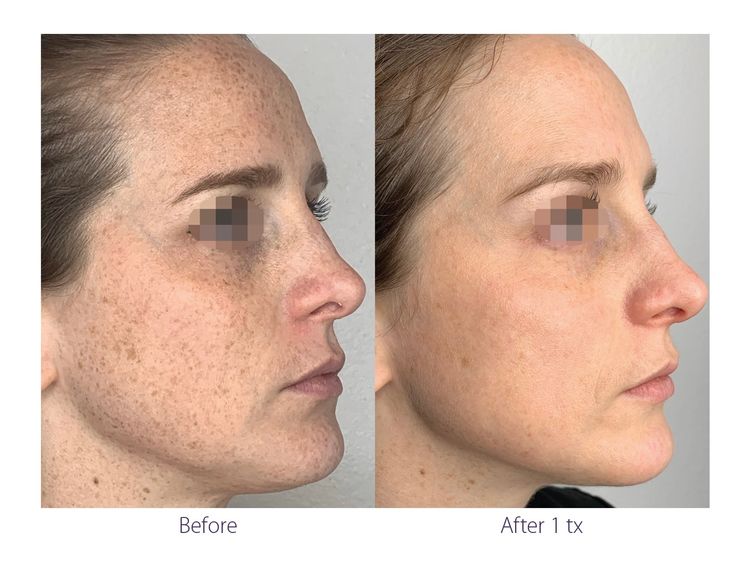
A clearer, more even-looking tone after one session.
Questions
Most sun spots and freckles need three to six sessions, three to four weeks apart. In published trials, most treated facial areas showed good to excellent clearing after three to five sessions, and hands cleared more often than faces in one study. Larger or deeper spots need more. We photograph and review after each session and stop when the result is reached rather than selling a fixed course.
It depends on the contrast between the spot and the skin around it. In Fitzpatrick types IV to VI the surrounding skin also absorbs the light, which raises the risk of burns, dark patches and pale patches. Our specialist dermatologists check your skin type, ask about recent tanning and often treat a test spot first. For some skin tones we recommend a Q-switched laser or prescription creams instead of IPL.
Not reliably. Melasma is driven by hormones and light, and reviews describe IPL as only moderately effective, with recurrence and a risk of rebound darkening. When we do use light for melasma it sits inside a programme of prescription creams and strict sun protection, and we explain the recurrence risk first. Our guide to melasma versus hyperpigmentation explains how we tell the two apart.
Yes, it can. Post-inflammatory hyperpigmentation appears when the treated skin overheats, most often in darker or recently tanned skin or when sun is not avoided afterwards. Pale patches are rarer. We lower the risk with settings matched to your skin type, contact cooling, a test spot where needed and four sun-free weeks on either side of treatment. Tell us straight away if an area darkens beyond the spots themselves.
Each pulse feels like a brief hot snap or the flick of an elastic band. Contact cooling on the applicator and a cooling gel reduce this. Skin is usually pink and mildly sore for a few hours, sometimes with a sunburn feeling for a day or two. Numbing cream is not normally needed.
IPL treats flat, superficial brown marks. It does not remove moles, raised age warts (seborrhoeic keratoses), tattoos or birthmarks that need a laser. It is not a treatment for a changing or irregular mole; we examine those and may refer for biopsy. Deep dermal pigment and post-inflammatory marks in darker skin usually need a different approach.
Treatment guides
Our guide to melasma versus hyperpigmentation explains why we identify the pigment type before choosing IPL, a laser protocol or prescription creams.
Melasma is one type of hyperpigmentation. Learn how it differs from marks after acne and why diagnosis changes treatment choices.
Every energy-based treatment at Evolution Clinic is performed by a licensed doctor with a specialist dermatologist qualification, within their approved scope and clinical privileges.
Specialist Dermatologist
Medical Director of Evolution Clinic, Specialist Dermatologist from Russia, M.D., Official Trainer for Laser Technologies. DHA License 03624607-001
Meet Yulia
General Practitioner
General Practitioner at Evolution Aesthetics Clinic in Dubai. DHA License 39929792-001.
Meet VeraIPL is a flashlamp. It emits a broad spectrum of light, roughly 400 to 1400 nm, and a filter selects the band that reaches your skin. The Dye-VL applicator on the Harmony XL Pro narrows that band to 500 to 600 nm, where melanin and haemoglobin absorb most strongly. Alma’s AFT filter converts the shorter, unused wavelengths into this useful range, so each pulse delivers even energy without the hot spikes of an unfiltered flash.
Melanin in a sun spot absorbs the pulse faster than the paler skin around it and heats. The pigmented cells are damaged, the spot darkens within a day or two, a fine micro-crust forms and lifts off over one to three weeks. The applicator’s contact cooling protects the surface while this happens.
Flat brown marks caused by sun respond best: solar lentigines (sun spots), freckles and age spots on the face, hands, décolletage and shoulders. In a 2025 systematic review of solar lentigine trials, the IPL studies reported good to excellent clearing in 74.6% of treated facial areas and 90% of hand areas, and pigment reduction in 94.4% of patients in another trial, mostly after three to five sessions three to four weeks apart. IPL was also less often linked to post-inflammatory hyperpigmentation than Q-switched lasers in that review.
The same 500 to 600 nm band is absorbed by haemoglobin, so Dye-VL also treats diffuse redness and small facial vessels. That is a separate plan on our IPL photofacial page.
We book IPL as three services: pigmentation treatment of the whole face, a small body area such as the backs of the hands, forearms or shoulders, and targeted removal of a group of spots. Body skin renews more slowly than facial skin, so flaking there can take the full three weeks and we space body sessions accordingly.
IPL works on contrast. Skin that is naturally darker or currently tanned contains more melanin around the spot, so the surrounding skin absorbs energy too. That is why Fitzpatrick types I to III are the most straightforward, type IV needs lower energy and often a test spot, and for types V and VI we usually recommend another route: our ClearLift Q-switched laser, our White Gloss pigmentation protocol for stubborn or mixed pigmentation, or prescription creams. Our dermatologists decide this at the consultation, not at the device.
IPL treats a field: many spots on a cheek or the back of a hand in one pass, with low downtime. A Q-switched or picosecond laser fires a single wavelength at a single spot and reaches deeper pigment; it is the usual choice for one dark lesion, for deeper dermal pigment and for darker skin types, at the cost of more visible crusting on each spot. Neither is "stronger" in general; the right one depends on how many marks you have, how deep the pigment sits and your skin type.
Melasma is symmetrical, hormone-sensitive pigment, usually on the cheeks, forehead or upper lip, and it returns when triggered by sun or hormones. Sun protection and prescription creams are the first treatment; light devices can add to that programme but do not replace it. Reviews describe IPL as moderately effective for epidermal melasma, with recurrence common and a risk of rebound darkening, and recommend continuing topical treatment for six to twelve months afterwards. We will not treat suspected melasma with IPL before a dermatologist has assessed it. Read melasma versus hyperpigmentation for how we tell them apart.
Dark marks left by acne, eczema, a burn or a laser hair removal session are post-inflammatory hyperpigmentation. They fade on their own over six to twelve months when the cause is controlled and the skin is protected from sun; a tinted sunscreen with iron oxide helps. Light and laser treatments can make these marks worse in darker skin, so we treat the cause first, for example active acne on our ClearSkin laser, and use IPL only where the mark is superficial and the skin tone allows it.
Do not have a chemical peel, microneedling or waxing on the treated area in the two weeks before a session. A PRX-T33 peel or a HydraFacial can be scheduled between sessions once the skin has finished flaking. LED light does not heat the skin and does not act on melanin, so it can follow IPL when your doctor advises it. Daily sunscreen and any prescription lightening cream your dermatologist recommends do more to protect the result than any add-on treatment.
Arrive with clean skin and no makeup on the area. We take photographs, confirm the plan and treat. Expect pink, warm skin and darker-looking spots when you leave.
We review your photographs three to four weeks after each session and decide together whether another one is worthwhile. New spots can appear with further sun exposure; a later session is a fresh decision after review, not an automatic booking. Sunscreen every day is what keeps the result.
Evolution Aesthetics Clinic holds DHA Polyclinic License 6000514. Our Alma Harmony XL Pro is an original device bought through the official UAE distributor, and we are happy to show you the paperwork. Every IPL session is performed by a licensed doctor with a specialist dermatologist qualification, after a face-to-face consultation in which we explain the expected result, the risks, the alternatives and the total price before you consent. You receive written aftercare and a direct route back to us.
Pink, warm or mildly sore skin for a few hours, a sunburn-like feeling for a day or two, and darkening of the treated spots followed by fine crusting are expected. Mild swelling can occur on thin skin around the eyes and on the hands. Bruising is reported in up to one in ten IPL treatments.
Blistering and superficial burns can occur, particularly on tanned or darker skin or with settings that are too high. Dark patches (post-inflammatory hyperpigmentation) or pale patches can follow a burn and may take months to fade; scarring is rare. IPL can also reduce hair in the treated area, which matters on a man’s beard line. Picked crusts can become infected, and a cold-sore flare is possible on the face.
Contact us the same day if you develop blisters, spreading redness, severe or increasing pain, pus or a fever, or if an area well beyond the treated spots turns dark or pale. Any eye pain or change in vision after a facial light treatment needs urgent medical assessment.
We postpone or decline IPL when any of the following applies, and we reassess at a later date where that is possible:
Pregnancy or breastfeeding.
Active skin infection, open wounds or dermatitis in the treatment area.
Recent sunburn, an active tan or self-tanner within the last four weeks.
Photosensitising medicines, such as certain antibiotics, unless your prescriber and our doctor agree it is safe.
A history of keloid scarring or poor wound healing.
Epilepsy triggered by flashing light.
A suspicious or changing mole, or a history of skin cancer in the area, until it has been medically assessed.
Melasma or hormonally driven pigmentation, which may respond unpredictably to IPL, unless a dermatologist has planned it within a wider programme.
Deeply tanned or very dark skin tones, where we recommend adjusted parameters, a test spot or a different treatment.
Licensing and an original device are important standards, but they do not remove the risks above.
Questions
Treated spots darken within one to two days, form a fine crust and flake off over about one to two weeks on the face and up to three weeks on the hands and body. The final colour of the area is judged at the review three to four weeks later, when we decide whether another session is needed.
Avoid heat, sweat and exfoliants for 24 to 48 hours; heat on freshly treated skin prolongs redness and raises the risk of dark marks. Mineral makeup can be applied once the skin is cool and unbroken. Do not rub or pick the crusts when removing makeup.
Yes, if you can keep the area out of the sun for four weeks before and after, which in Dubai means shade, a hat and SPF 50 rather than a beach holiday. Tanned skin is declined on the day. Many patients time face treatment for weeks when they are mostly indoors, and treat hands and shoulders in the cooler months.
Some diuretics, some antifungals and St John’s wort increase light sensitivity and can cause burns or dark patches. Bring a list of everything you take, including supplements. Do not stop a prescribed medicine yourself; our doctor will decide whether to postpone or adjust the plan.
LED red light does not heat the skin and does not act on melanin, so it does not interfere with the IPL result. Whether we add an LED session depends on how your skin reacted; we decide at the appointment rather than bundle it in advance. Sunscreen and a gentle routine matter more for recovery than any extra light.
Related reading
Manufacturer, dermatology and peer-reviewed sources used for this page.
